
The Sewing Machine
 Submitted by
 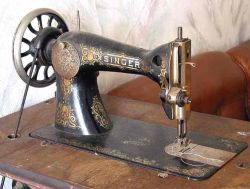 Before returning from a recent trip to Taipei, a last-ditch hunt at the Taipei airport for local culinary cuisine turned up more just than a steaming bowl of beef noodles. I found a thematic food court with the 1960s as its theme. But what caught my eye was not the coffee shop tables and cutlery that were a blast from the past. It was a small, plain, wooden and metal contraption, easy to miss amongst the many antiques scattered around the area.
Yet, the moment I saw it, I caught my breath and my heart skipped a few beats. It was a manual "Singer" sewing machine, complete with needle guard, pedals, drawers and the "Transformer"-like drop-in casing which allows it to be neatly hidden away during festive seasons. I opened the drawers, played with the spindle, and traced the old cuts that marked the wooden fold-out flap, just like I had done so many times, decades ago, as I played out my childhood adventures on my mother’s sewing machine.
When I was in Primary 2, we had to tell the teacher what our parents’ occupations were. My classmates were mostly from the well-to-do and spoke of parents that were teachers, doctors, managers and businessmen. When it was my turn, I struggled to come up with the correct terms and finally said, "My father is a bag-maker," as per what I remembered was written on my birth certificate.
There was silence, before the teacher corrected me. "No, you should say that your father is a factory worker."
"But he makes bags," I protested.
She ignored me. "What about your mother?"
"My mother is a sewing-machine," I said. There was another silence before the giggling started. The teacher rolled her eyes.
"Where does your mother work?".
"She works at home," I replied.
"Then your mother is a housewife."
"But she sew clothes for people for money," I argued again.
"Your mother don’t go out to work but stay home to look after you and the house, right?", she asked.
"Yes. All the time. She doesn’t go out to work."
"So she’s a housewife," concluded my teacher briskly.
At that point, I just kept quiet. The teacher wouldn’t understand. My mother did indeed stay home to look after my siblings and myself. But she was also the main bread-winner of the family.
As a mother, she was always there for each and every one of her seven children, caring for us when we were sick, and bearing with all the nonsense that we put her through as we grew up. And as a seamstress, she was a sewing-machine that worked non-stop, 24/7, weekdays and weekends. When she’s not mothering us, she’s plugged into the machine, her right foot stepping on the pedal feverishly, transforming cloth into clothes by the hundreds. She was the engine that drove the sewing machine; and the endless chug-chug sound it made was to me the sound of her very heart-beat and a lullaby that lulled me to sleep every night. Each time she completes a batch of clothes, we would help her fold the clothes and tie them into bundles with strings. We will then make the trip down to the shop to hand in the clothes so that she can collect her pay of a few dollars.
As early as I can remember, we all had our duties to do, my sisters will do the cooking and laundry, I will do the sweeping and mopping of the floor. We just did it without complaining, because we knew we had to free up our mother as much as possible so that she can focus on doing what she had to do. She did it without complaining, even when her body was wrecked with arithritis and piles, and her hip gave way from the years of stress at the machine. She only had one goal, which was to keep at it until all her children were able to take care of themselves, and hopefully, her.
Her super-human effort did indeed see the last 3 out of her 7 children through to our university degrees, but her body gave up soon after. She barely lasted 6 years after my graduation before she was felled by a massive stroke in 1996. To this day, my greatest regret was how I had focused so hard on setting up my own career and family during those early years that I neglected to make time to spend with my mother in her last years, to bring her around the world so that she can see the things that she had, through her own efforts, allowed me to see.
My mother was an illiterate woman. She never taught me a word of English or Chinese. She never read a storybook to me. She never helped me with my homework. But her immense love and the personal sacrifices she made for the sake of her family is manifested in each and every one of her children today. We are able to live as we do today, only because of this incredible sewing machine. For all the effort and money that I spend on my kids’ education and enrichment today, I still do not think I can match up to even half of what my mother has given to me in terms of the best part of her life.
I wish Happy Mothers’ Day to all mothers, past and present, this coming Sunday. It is easy for us now, as parents, to understand the pain that our own parents have gone through to bring us up. For those who still can, make sure you tell your mother how much you love her.